

Dwell Or Die? (Genesis 25:18b)
Asher Chee |
Bible translations provide diverging understandings of Genesis 25:18b:
Genesis 25:18b NKJV He died in the presence of all his brethren.
Genesis 25:18b ESV He settled over against all his kinsmen.
So which is it? Is Genesis 25:18b telling us that Ishmael “settled” or “died”? The Hebrew word translated “settled” in the ESV or “died” in the (N)KJV is the verb nāphal, which usually means “to fall” in most contexts. Therefore, our interpretation of Genesis 25:18b depends on how we understand the verb nāphal “fall” in this context: What does it mean that Ishmael “fell”?
“Died”
On the one hand, nāphal could be understood as having a negative connotation in this context, as it does in many other biblical passages. This is analogous to talking about the “fall” of a person as the undoing of that person in English. This view understands Genesis 25:18b to be a restatement of the death of Ishmael in the previous verse:
Genesis 25:17 ESV These are the years of the life of Ishmael: 137 years. He breathed his last and died, and was gathered to his people.
“Dwelled”
On the other hand, however, it is more likely that Genesis 25:18b is the fulfillment of the prophecy regarding Ishmael recorded in Genesis 16:12:
Genesis 16:12 ESV He shall be a wild donkey of a man, his hand against everyone and everyone’s hand against him, and he shall dwell over against all his kinsmen.
While this is obscured in many translations, both these passages are actually identical word for word in the original Hebrew text, except for the last word:
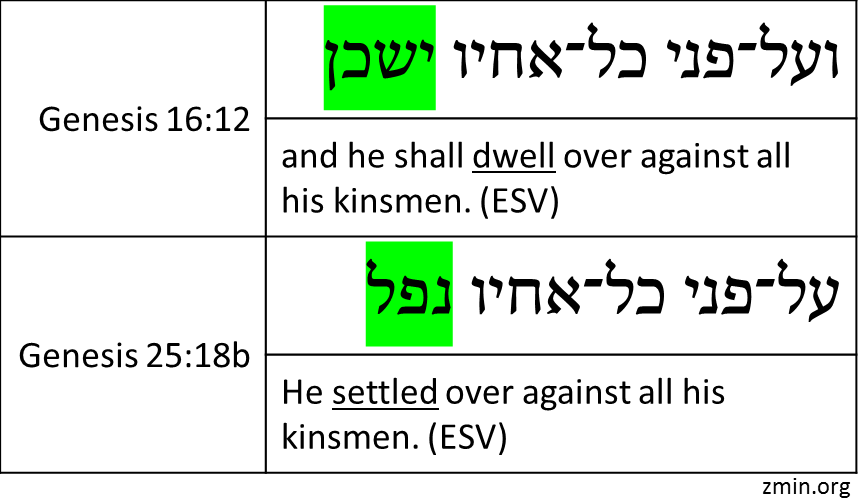
Therefore, it is more reasonable to think that nāphal “fall” in this context means that Ishmael “dwelled” in the same place with his kinsmen.